
130 Years of
St Edmunds
Celebrating 130 years of history, community and progress. For 130 years, generations of students, Fellows, staff and alumni have shaped a welcoming community built on academic excellence and inclusivity. Explore the milestones and stories that have defined our journey.
Explore timeline

Present
2026
30 Years
since becoming a fully fledged Cambridge College.
Three decades after becoming a fully fledged Cambridge College, St Edmund's continues to build on its rich heritage, embracing academic excellence while shaping future generations.
Discover this milestone
Life at St Edmund's
A glimpse into student life, the college community, and everyday moments from the 2000s.
Watch videoExpansion
1940s
27 April 1940
Assumed completion of additional building wing with dining hall and additional rooms.
28 July 1937
Completion of extension of building with new library, new kitchens, rooms offices etc.
27 February 1935
Birth of Brian Heap

21 August 1934
John Edward Petit was elected as the 7th Master. During his tenure, student numbers grew significantly, supported by education reforms, while fundraising and campus expansion strengthened the College's future.
Read more23 June 1929
Thomas Cuthbert Leighton Williams, the third Master of St Edmund's and its youngest ever Master, was elected at just 32 in 1909. Following the construction of the College Chapel, he felt called to support the war effort, serving as chaplain to several military hospitals from 1916. He resigned as Master in 1918 to become a chaplain to the Armed Forces on active service.

15 August 1928
Death of Anatole Von Hügel
3 April 1923
St Edmunds House Society founded.

23 May 1922
1st Meeting of Finance Committee being erected in 1921
8 April 1921
Election of 5th Master John Francis McNulty. During his tenure, he strengthened the College's finances, established a finance committee, and attracted American students and funding, helping secure the College's future.
Our goals
1920s
22 July 1918
Governing Body considers closure due to war, but was agreed to remain open
11 June 1918
Joseph Whitfield elected 4th Master. He had a record of service, receiving commission as Chaplain 4th Class (Temporary) to the Land Forces on 29th August 1914 with him being rewarded a D.S.O. on 8th March 1918
11 February 1917
Death of Henry Fitzalan-Howard, 15th Duke of Norfolk, co-founder of St Edmund's

16 October 1916
The Chapel was opened and blessed
5 November 1915
Foundation stone of Chapel laid

11 May 1915
Decision to begin building the College Chapel agreed at Governing Body. Designs were commissioned by Fr Benedict Williamson, who was also an architect. The idea of building the Chapel came after a surprise donation by Miss Sperling in 1910 for the purposes of building a chapel.
12 July 1913
William Prior, the gardener, attacked one of the housekeepers. He gave himself up to the police to be admitted to Fulbourn Hospital.
17 January 1910
Decision made to admit the first laymen to St Edmunds. Not enough priests were being sent to meet the financial needs of the House. Although the admission of laymen did not initially make much of an impact. One layman was admitted in October 1911 and another in January 1911.
11 May 1909
Thomas Cuthbert Leighton Williams, elected the youngest-ever 3rd Master of St Edmund's at 32, resigned in 1918 to serve as a military chaplain during the First World War. He later became Archbishop of Birmingham in 1929.
Read more
January 1909
Public Appeal written by Von Hugel published
16 October 1908
Foundation of the Literary Club. The club was established for the purpose of hearing and discussing papers and holding an occasional symposium. It began life as The Literary Club but appears to have come to be known as The Thirteen Club in 1912.

2 March 1903
First Von Hügel-Froude scholar appointed
Our foundation
1900s
2 November 1896
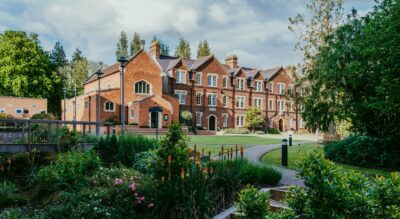
Nolan and the first four students took residence at Ayerst Hostel, the site of the present Norfolk Building.

25 September 1896
Ayerst Hostel purchased, which would become the Norfolk Building
4 June 1896
Application of affiliation was graced by the Congregation
15 January 1896
Nolan appointed chaplain to the Catholics in Cambridge (i.e. Fisher House)