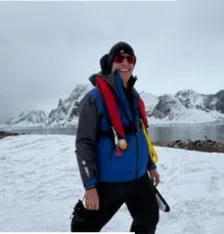


You may have heard alumna Sofie on the airwaves recently (BBC Radio 2 with Jeremy Vine, BBC Radio 5 Live with Nicky Campbell and Laura McGhie, BBC Three Counties, and LBC News), where she discussed the complex relationship between Greenland and Denmark, Greenlandic independence, and the United States’ strategic interest in the territory.
Sofie is an international policy researcher at the think tank IPPR, where she focuses on how the UK should navigate its geopolitical alliances in an increasingly multipolar world. She is also part of the leadership team at the professional network Women in International Security and sits on the advisory board of the Wonder Foundation.
She took time to reflect on her memories of Cambridge, share her perspectives on geopolitics and current affairs, and offer sage advice to those aspiring to build a career in international policy.
Life at Cambridge
Q: You’re originally from Denmark. Can you tell us about your journey to Cambridge and how you ended up at Eddies?
A: Almost all Danes take gap years before going to university, where we work full-time jobs and go travelling, while we figure out what we want to study. So, when I was picking a college to apply for, I only really looked at the mature colleges, as I thought it would be nice to be around other people who had not gone directly from school to university. I then picked Eddies, because it was the most international college – and that ended up being one of my absolute favourite things about Eddies.
Q: You studied HSPS as an undergraduate. How did that experience influence your career path and your vision for the future?
A: When I applied to HSPS, I wanted to study international relations, but I ended up doing sociology. Then I did a master at LSE in anthropology and development, and now I work in foreign politics. I think that journey really shows the strength of HSPS. It is such a broad degree, so it keeps a lot of doors open while you figure out what you are interested in and what you want to do – I definitely benefitted from that.
Q: Are there moments from your college days that still stick with you, moments that shaped your personal growth?
A: In my second year (2021-2022), I was the sports officer in the CR, and the pandemic meant most of the college sports teams had gone dormant, but there was this amazing group of people who stepped up to be captains of both old and new sports societies. It felt like a real community effort to rebuild sports at Eddies, and within a year we had more than 10 different teams playing competitively in the college leagues and more than 150 students who were part of college sports clubs. It is probably what I am most proud of from my time in Cambridge, and it taught me a lot about community building and organising.
Q: Are there lessons from your time at Cambridge that continue to shape the way you approach your life and work today?
A: Moving to a new country in the middle of the pandemic and studying in the pressure-cooker environment that Cambridge undoubtedly is taught me humility and resilience. It pushed me to become comfortable with uncertainty, to accept that I would not be among the best no matter how hard I studied, and to then shift my focus from perfection to progress. Now, early in my career, I once again find myself as the person who knows the least in the room, but this time I am completely okay with that and see it as a valuable opportunity to learn and grow.
Life today
Q: You’ve recently appeared on podcasts and news outlets discussing the US’s ongoing interests in Greenland. How has your Danish background influenced the way you see global affairs and how has engaging with the media shaped your perspective or work?
A: Growing up in Denmark has shaped my outlook on global affairs in very fundamental ways. As a small social democratic country, multilateralism and the rules-based international order were never a “nice to have” for Denmark, they were necessities. International cooperation, institutions, and legal frameworks gave us protection, influence, and a seat at the table, and that experience made me a natural supporter of internationalism. At the same time, that world now feels uprooted, and the US interest in Greenland has made the limits of those systems much clearer for us Danes.
Working in geopolitics and following current affairs so closely can be emotionally quite taxing, and in the case of Greenland the professional and personal have definitely blurred. Engaging with the media on this topic has forced me to think not only about what is analytically sound, but about how arguments land with different audiences and how best to reflect the multiple hats I wear in this as a Dane living in London working with geopolitics.
Q: In your day-to-day role at the Centre for Geopolitics and International Policy, are there particular regions or issues you focus on, and why?
A: I mainly focus on what it would look like for the UK to build more modern and mutually beneficial partnerships with “countries of the global south”. The world is changing, and the UK’s place in the world order is changing too; relying on the US and Europe will no longer be enough to deliver on domestic policy priorities like energy security and economic growth. We often get so caught up in talking about great power politics, but it is really important to not lose sight of the longer-term strategic choices that the UK will have to make when it comes to emerging powers too.
The future
Q: What advice would you give to students or young professionals aspiring to work in international policy?
A: Working in policy, especially in a thinktank, is about so much more than doing research and writing policy. A lot of the job is about stakeholder management, event planning, writing funding proposals, communication and media, having good organisational and administrative skills. So, if you want to go into policy, it is important to have a diverse skill set and being involved in the CR or other societies is a really great way of gaining that. You also need to consider if you would prefer to be a specialist or a generalist – is there a region or a topic you are particularly passionate about, or would you find it more interesting working across a large set of policy areas?
Q: As you look to the future, which emerging trends in geopolitics and international policy do you find most compelling or most concerning?
A: We live in a “world between orders” that is increasingly characterised by multipolarity. Sure, there will still be great power competition, but I think the more interesting trend will be to follow what middle-power alliances will emerge underneath that. I think we are likely to see more plurilateral “coalition of the willing”-type alliances that will be based on shared geoeconomic interests, like supply chain resilience. This trend would likely have happened regardless, but Trump’s unpredictability has turbocharged this development. But this focus – however important it is – makes me worried that we will neglect agendas on climate change and sustainable development goals completely.
Have you got an inspirational story to share?
The Comms Office would love to hear from you. Contact the Comms Office.