From Malaysia to Cambridge: empowering the next generation through AI-driven opportunities
Originally from Malaysia, Cambridge entrepreneur John Tan (he/him) first arrived at Cambridge in 2022 to pursue an MPhil in Knowledge, Power, and Politics at St Edmund’s College. He had previously completed his undergraduate degree at Fitzwilliam College. Today, he is the founder of Palpable, an AI-powered jobs board designed to make early-career job searching simpler, faster, and far more accessible.
After spending several years immersed in Cambridge’s rapidly growing innovation ecosystem and working alongside leaders such as Emil Hewage and Aleksi Tukiainen at Cambridge Applied Research, John reflects on his journey from student founder to start-up builder, and how Palpable is helping graduates navigate today’s fast-changing job market.
Your journey to Cambridge
Can you tell us about your personal journey to Cambridge and what life for you looked like before you joined the University?
My love for building things started long before coming to Cambridge. Back in 2016, I founded CoverShr, an edtech start-up that let students write about their academic interests without the hassle of creating their own blog from scratch. The platform grew to over 60,000 users, a rewarding introduction to the world of start-ups and edtech.
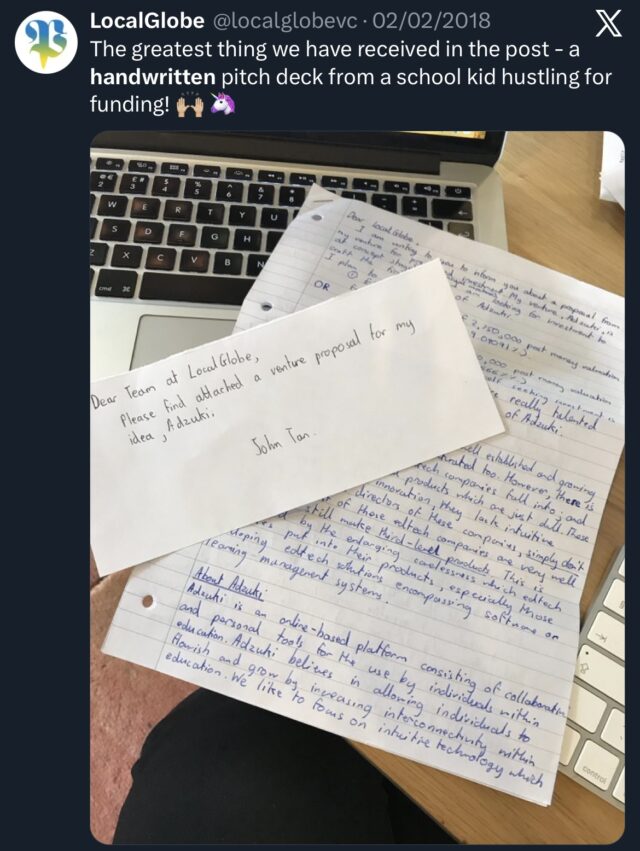
Around that time, I also remember sending handwritten letters to venture firms across London for another education start-up called Edzuki (formerly Adzuki). It was my way of dipping my toes into the fundraising world and understanding what it would take. These early experiences shaped my interest in start-ups and showed me how ideas can become products and services people genuinely find useful.
Handwritten letters do really open doors
In light of this interest in education and technology, I applied to Cambridge interested in honing in on an understanding of the complex relationships between human capital, technology and policy.
I’m proud to call Cambridge home, twice over. I first graduated from Fitzwilliam College in 2022 with a degree in Policy and International Development, before moving to St Edmund’s College for my MPhil in Knowledge, Power, and Politics. My academic path has always gravitated toward the intersection of technology, knowledge, and human potential. My master’s thesis explored how modern technologies reshape our very conception of “being.” (Yes, it was just as philosophically intense as it sounds!)
During my time in Cambridge, I interned at Cambridge Applied Research, an open innovation company founded by Cambridge alumni Emil Hewage and Aleksi Tukiainen (also a St Edmund’s alumnus). I spent two summers on Hills Road building energy-tech products just as Cambridge itself was transforming into a national innovation hub. Watching that evolution first hand, from research city to start-up powerhouse was nothing short of inspiring.
Introducing Palpable
What is Palpable?
Palpable is an AI-powered jobs board for entry-level and junior roles. Over 200 roles are posted daily for graduates and those at the start of their professional career to apply to. We do this with the help of AI, which helps us detect job openings, specifically junior roles, from over 300 sources. We already have 6,000 monthly users from leading universities such as Cambridge, UCL, and Imperial, and we’re growing fast (whilst bootstrapped too!).
Our mission is to become the go-to jobs platform for entry-level and junior candidates searching for global opportunities. We imagine a world where the next generation of doers has a place in the age of AI and automation. We also want this next generation to have access to every opportunity, no barriers and no hassle.
What motivated you to become an entrepreneur?
I’ve always had a knack of turning ideas into products that people actually find useful. Just like how academia and research works, I think there’s a novel feeling of delight when you can turn something as fragile as an idea into something tangible like a product or platform that makes people’s lives a little bit less painful. And of course, puts a smile on their face.
Growing up, I liked the idea of experiments- the freedom to test a playground of ideas without fear or embarrassment if they failed. What motivated me to stay in start-ups and keep this entrepreneurial spirit is the mindset of trying new things and not worrying too much about failure. One of my role models, Nobel Prize winner Dr Rainer Weiss, once said during a roundtable that winning the Nobel was never his aim. He was simply having fun and surrounded by friends, and that’s what pushed him to do what he truly wanted.
I believe I share a similar perspective – working on experiments is hard, but if your frame of mind is that you’re having fun and trying to solve a difficult problem, then what’s the harm after all?
A spark that led to Palpable
Was there a particular moment or experience that inspired your start-up idea?
When I was interviewing for junior roles whilst working at a previous start-up, we had about 1800 candidates for 3 intern roles. I remember asking candidates during these interviews what really was challenging about the whole job-hunt post-graduation. There were a few reasons but the main one was the time it took jumping from one company to another, or one job platform to another, just to find relevant roles.
I kept hearing this issue throughout the whole hiring experience and at that time, I didn’t really think much about it. But when I took some time away from my career, there was this restlessness I tussled with. I remember asking myself, there has to be a better way to search for jobs if you’ve just graduated. And so that led me on to conduct even more user interviews only to find that this pain was still persisting.
What has been your toughest challenge so far, and how did you overcome it?
To be frank, every morning brings a new challenge. It might be a feature that breaks because of a bug. Sometimes it’s a user reporting an issue. Either way, you quickly learn to develop a tough skin. There’s a common saying in start-up land that you’re always putting out fires. Most days, that feels true.
There is always something to fix. As a founder, my main job is to clear the bottlenecks that appear each day. Sometimes that means making a quick decision to move an issue forward. Other times it means deciding whether to attend an event that could bring in more users. What keeps me steady is remembering that small, consistent steps add up. That mindset helps me handle the moments when things don’t go to plan.
Writing down the next steps, even the tiny ones, is hugely underrated. When the next move is clear and practical, it’s easier to stay focused. Progress is just a collection of small steps, repeated with consistency. That’s how I deal with challenges.
How do you see your start-up impacting the world in the long term?
My vision for Palpable is to empower the next generation with access to opportunities around the world. It’s a world where a computer science graduate in Tokyo can work for a Paris-based organisation, or a design student in Copenhagen can intern at a Texas-based manufacturing company. We want every graduate to have access to global opportunities.
We believe there is still a place for human beings in an age shaped by automation and AI. It’s a world where our humanness can thrive, where ideas can grow across borders, and where the next generation can solve big challenges through genuine togetherness.
But first, a simple job board that gives access to the world’s opportunities!
What advice would you give our Eddies students thinking of starting their own venture?
Go work for a start-up! That’s my top advice. I hear tons of young people wanting to build their own venture and I love it! But if you really want to build a successful venture, you should put yourself in the deep end and learn from others already doing it. You’ll learn what to do and what not to do. You’ll be thrown into sales or distribution, product or legal. You’ll want to spend a few years witnessing what a start-up feels like and how they operate.
And then you can ask the question: is this really for me? says Cambridge entrepreneur John Tan.
If you’d like to read more stories like John’s, then head over to our student profiles page.