


Don’t look back in anger
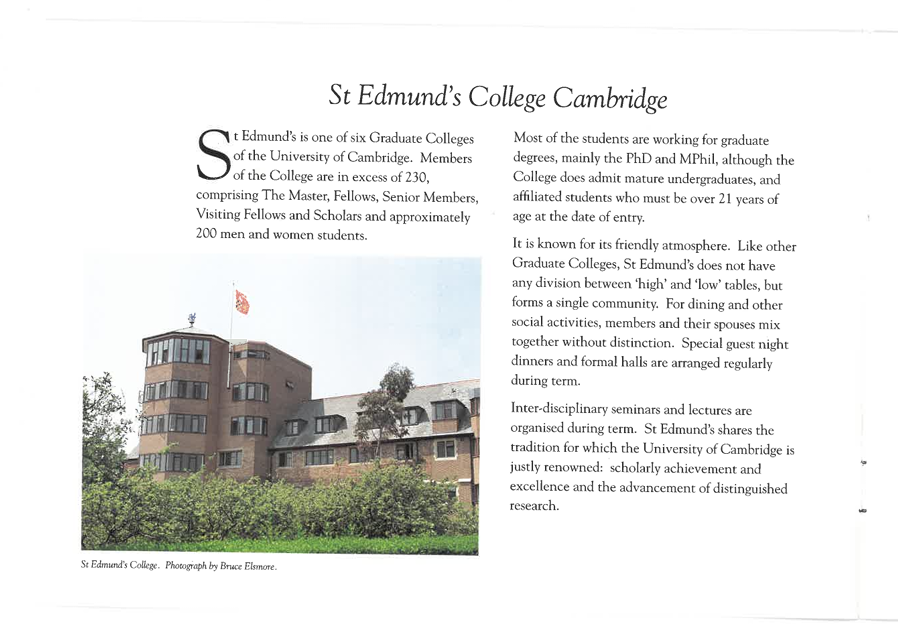
In 1996, St Edmund’s marked 100 years since it welcomed its first students. A boarding house for six Roman Catholic priests had grown into a community of around 200 scholars from around the world. The year also marked the start of a new chapter.
Since 1896 St Edmund’s’ stature had risen steadily, being accepted by the university as a graduate college in 1965 and designated an ‘Approved Foundation’ in 1975. The last step was taken on 22 March 1996, when St Edmund’s’ application for full collegiate status was approved (subject to it obtaining a Royal Charter, which was granted by HM Elizabeth II on 22 April 1998) and St Edmund’s finally became a constituent college of the University of Cambridge.

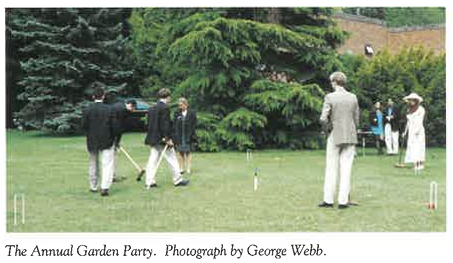
The centenary was marked by formal celebrations. The Duke of Norfolk joined the Norfolk Commemorations. The Archbishop of Westminster, Cardinal Basil Hume, gave a special Centenary Mass. A Centenary May Ball was held. On 25 June, St Edmund’s hosted Prince Philip, the Duke of Edinburgh and Chancellor of the University, at a Centenary dinner. In August, the outgoing Master, Professor Richard Laws, welcomed guests to his last Garden Party and a performance of The Taming of the Shrew. A range of commemorative souvenirs were commissioned, including mugs, glass tankards, and a special Centenary teddy bear.
It was an exciting time. The Centenary coincided with the era of Cool Britannia, when British music, design, art, fashion, film, and youth culture were associated with a confident, outward-looking Britain. In the US, Vanity Fair put Liam Gallagher and Patsy Kensit on the cover and declared London swinging again. After 18 years of Conservative government, a youthful Tony Blair and New Labour looked set to take power. New information technologies were changing business and communications. Dolly the Sheep put British science in the global spotlight. Some of this may have seemed a world apart but, inevitably, what happened in the wider world was felt at St Edmund’s.
The start of the academic year in October 1996 saw the arrival of a group of new students from around the globe, the first to matriculate at St Edmund’s as a constituent college. It also saw the arrival of St Edmund’s’ twelfth Master, Professor Brian Heap. We spoke with four of the class of 1996 to find out what life at St Edmund’s was like at this historic moment.
1996 in photos
The class of 1996
Before coming to St Edmund’s, Liam Canny had spent four years in the U.S. Coast Guard, two of them chasing drug runners in the Caribbean. He finished as a Lieutenant. After military service, he used GI Bill support to pursue a Master’s in Irish History at Queen’s University Belfast, then the MPhil in International Relations at Cambridge. He was drawn to St Edmund’s by its Catholic identity. Grandson of four Irish immigrants to America and a graduate of Notre Dame University, “I just felt very at home in a college with a Catholic identity,” he says. “That there was a Catholic chapel was very comfortable for me.” Getting in at Cambridge was a serious achievement.
“I came from a lower middle-class kind of background and I was, like, ‘I’m going to one of the greatest academic institutions in the world.’ I was super-humbled by the fact that I was admitted.”
Zhou Bo arrived for the MPhil in International Relations having already served seventeen years in the Chinese People’s Liberation Army, reaching the rank of Lieutenant Colonel. Awarded a Chevening Scholarship, he chose Cambridge despite doubts from others. “I think here audacity played a small role because I’m just more bold than other people,” he says. Choosing a college was harder. “I read the brochure of every college, they’re just beautiful in different ways. You can hardly know which one is better.” In the end, serendipity played its part. “I was afraid of being rejected by Cambridge, so I wrote a letter telling them whichever college accepted me the quickest would be accepted by me with all pleasure. I didn’t choose St Edmund’s. They chose for me.” He felt incredibly fortunate. Being able to study abroad was “the highest possible dream for any Chinese at that time and this was almost a godsend, a good opportunity for me. I felt so, so lucky to be chosen.” Bo was the first PLA officer to study at Cambridge and one of only six Chinese students at St Edmund’s in 1996.
I didn’t choose St Edmund’s. They chose for me.
Claudie Grisus arrived for the one-year LLM course having already completed five years of higher education. She was the only student from Luxembourg and had studied English and Law in Luxembourg and Paris. Like many of her classmates she knew very little about the College or its history. “It wasn’t very important to me which college it was”, she admits.
Jim Strang came from Scotland to study for an MPhil in Finance. “I was intrigued by the whole Cambridge thing” he says. He had done an undergraduate degree in Edinburgh and was working for an investment company that sponsored him through an MSc at Stirling. Keen to continue academic research, he began a project with his Edinburgh professor alongside his job. The professor suggested he apply to Cambridge. Drawn to St Edmund’s as a mature college, he knew “not a sausage” about its history or Catholic heritage. After getting an offer of a place, he felt “excited and a bit nervous, but more, way more, excited than nervous.”
First impressions
Coming to Cambridge was a novel experience for all of them.
Bo had never been to Britain before. “It was a totally unexpected new experience.” Coping with British weather and the shortening days of Michaelmas term was the immediate challenge. “It was so dark,” he remembers. Being far from home with few compatriots was sometimes hard. “I was on a bus, I think it was about 3 or 4 o’clock. It was almost totally dark. It was a bit raining and I suddenly felt so, so lonely. I desperately wanted to talk to some Chinese and I couldn’t find a Chinese inside college. The best person I could talk to is a Taiwanese who is Chinese but still different.”
Claudie’s first test was accommodation. Although plans were being laid for several new buildings, in 1996 many students had to live outside College. “I had to find a flat, which was a nightmare,” she recalls. “I had to look at these really rough, shabby places on the first floor of shops that served chicken nuggets and really smelly stuff, all very expensive”. In the end she moved into a house on Gilbert Road.
Jim’s first impressions were of “a slightly faded grandeur around the building” and “amazing grounds out the back”. He was struck by the people. “It felt like a very eclectic mix of people and personalities but friendly people, infectiously friendly people.” Walking around Cambridge St Edmund’s’ difference from the other colleges became apparent: “it’s got its own personality and it’s different, and that’s a great thing.”
Liam arrived expecting Cambridge to be dominated by tradition and hierarchy. “I thought it would be people in tweed jackets, smoking jackets” he laughs. “I’m Irish, the grandson of two Irish rebels, and I’m going to this bastion of British authority.” Instead, he found an international and welcoming community. He was allocated a room in a house on Castle Hill, close to the Carpenters’ Arms. “The first weekend was great”, he remembers, with wild nights with his English, Irish, Canadian, and American housemates. He liked how St Edmund’s’ humble atmosphere contrasted with the grandeur elsewhere. “You’d go to John’s, to King’s, to Trinity, and you’re, like, ‘wow, this is how the other half lives’”, he says. “We’re just the poor Catholics up the hill, which for me was perfect because I was a poor Catholic, and I was Irish, and I was a Rebel.” His fears that Cambridge might be dour and dowdy, hidebound by tradition, proved misplaced. “Cambridge is so cosmopolitan in its composition of students and it’s in this beautiful setting.”
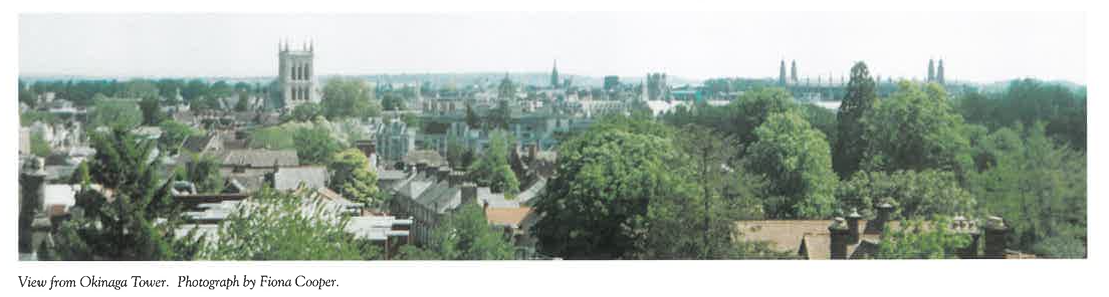
View from the Okinaga Tower

Work
As it has been for generations of students, academic work lay at the heart of their Cambridge experience.
Jim admits now that the Finance course “was at some points hilariously intimidating”. The lecturers “were slightly barmy, they were on an interplanetary different level” he says. Among them was James Mirrlees, who had to excuse himself from teaching one day to collect the Nobel Prize in Economics. The mathematical side of the course proved especially challenging. Faced with complex proofs scrawled on blackboards and only partial explanations, Jim and his classmates enlisted the help of gifted Romanian students. “It was comedy,” Jim remembers. “We were so lost.”
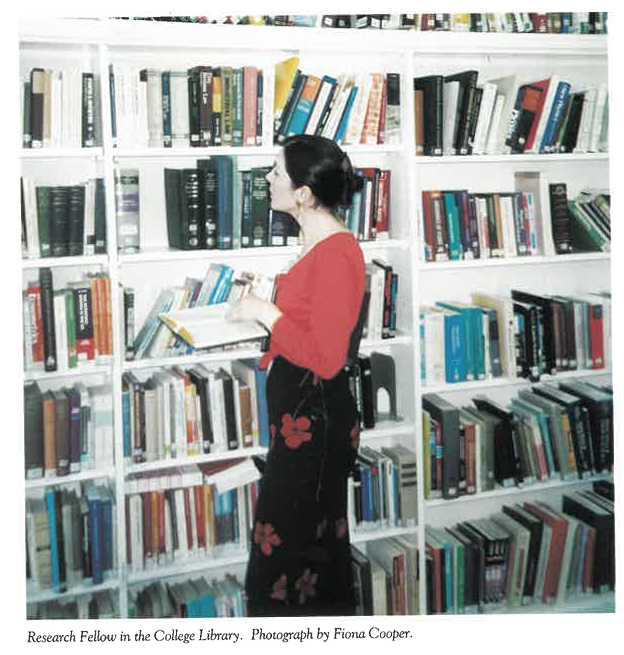
Bo was struck by the intensity of the workload. “The curriculum is totally, totally insane in Cambridge.” Mindful of his duty to the PLA, he threw himself into his studies. Many hours were spent in the St Edmund’s library working through reading lists and unfamiliar material. “I quickly became short-sighted,” he recalls. “I went to see the doctor. He said, your eyes look really angry! So I went to have my first pair of glasses.”
For Liam, the International Relations course was a marvel, with teaching by leading scholars in the field. But he still remembers a hungover oral examination after a night “on the razzle” celebrating final submissions. After what seemed like an age, he breathed a sigh of relief when one of his interrogators smiled and told him everything was OK, he could go back to last night’s party. “I was mortified. I came out still sweating,” he laughs, “but I got through that experience.”
Claudie loved the LLM course. “It was very exotic, a completely different system, and I had to do loads of research on my own.” The volume of work was a surprise. “It was a huge workload”, she says, “I didn’t expect it to be that much. I was sitting day and night studying.” One experience still causes nightmares. After submitting an important paper she discovered two vital pages sitting in her printer at home. “I almost had a heart attack,” she says. “Part of the argument was missing.” She rushed back with the missing pages but the deadline had passed. “I still dream about this. I see myself begging that lady, ‘please, please, I have two pages.’ No, no, no.”

Sports
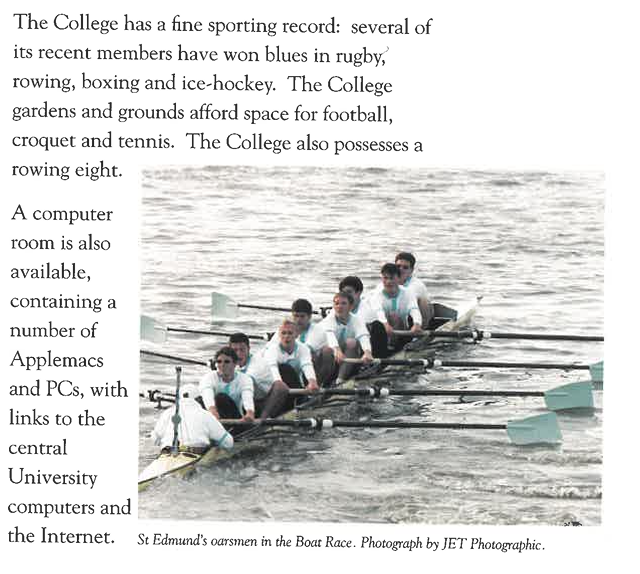
Of course, Cambridge is not only about academic work. The mid-1990s were golden years for St Edmund’s sport, with the college home to several star athletes. College members featured prominently in successful Varsity rugby and rowing squads, while others represented the University in polo, hockey, tennis, skiing and ice hockey. With two Blues in the boat, the St Edmund’s Men’s First VIII achieved blades in the 1997 May Bumps. St Edmund’s also had successful rugby, squash, table tennis, pool, and cricket teams, and, from 1995-1996, a revived football team. Nicknamed ‘The Donkeys’ and easily the most international squad in Cambridge, in 1996-1997 it won the AFC Shield and was runner-up in the MCR Cuppers Competition.
Jim and Liam threw themselves into College sports, relishing the opportunity to compete alongside some of the university’s most talented athletes.
Jim rowed in the blade-winning Men’s First VIII and played rugby. In Ethan Ayer and Alex Story “we had these two galactical rowers,” he says. “We had a few other folk who knew what they were doing, and then we had a bunch of numpties, including me.” He was struck equally by the College’s rugby talent and despite not being at quite the same level, played occasionally for the College team. He also joined the University Golf Club, playing a few games for the Stymies. Seeing how elite athletes like Ethan Ayer and Tom Murphy set goals and learned from their performances was a lasting lesson he applied to the rest of his life.
Liam coached the Blues basketball team and played in goal for the College football team. He remembers using St Edmund’s spacious grounds for training, deploying jumpers for goalposts on the fields behind the maisonettes. He was taken by the post-match refreshments. “You came off the pitch and there would be a pavilion. The porter would lay out this table with a tablecloth and there were these half-pints of shandy. It was fantastic.” He somehow found time for squash too. “I was playing more sport than I was studying,” he admits. “I wasn’t doing my research or writing until it was dark. I was in this nocturnal existence.”
For Claudie, however, sport held little appeal. “I couldn’t get up at six in the morning.” She preferred the joys of shopping and admits to “spending hours at the beauty section of Boots” and discovering the joys of Marks and Spencer’s food section.
Social life
There were plenty of other ways for students to come together. Freshers’ Week featured wine tastings, pub crawls and bar nights. Formal dinners, guest nights and bops filled the calendar.
Claudie adored formal dinners and parties. “You had to dress up and wear the formal gown, which I really loved because it was so exotic to me.” She found the gong used between courses hilarious. The parties were simpler than they might be today. “There was a radio playing music,” she laughs. “In 1996 we didn’t have Spotify and playlists.” Britpop provided the soundtrack. Blur, Oasis and other bands of the era echoed through parties and student rooms.
Jim remembers barbecues in all weather at his Zimbabwean friend Tim Whetmore’s maisonette. “Tim would be like, ‘It’s a barbecue!’ And we’d be, ‘Tim, it’s the end of November!’” For the year, the maisonette was nicknamed Tim and Bobby’s Barbecue Shack. He enjoyed everything Cambridge had to offer. “We went out tons. There was one nightclub, down the back next to Sainsbury’s, and another couple of places we used to go.” It was not just the nightclubs. “The College was full of energy. That little bar was jumping all the time. I’m glad I was young and I had the energy to do it because even thinking about it now, it makes me exhausted!”
He also remembers the atmosphere of the wider era. “It was all Cool Britannia, Blairism in its pomp. There was just so, so much going on.”
For Liam, the election of the Labour government in 1997 was memorable. “There were quite a few British students on our course and they were elated with this changing of the guard.” For him, the progress of the Northern Irish peace process was even more significant. “It was a euphoric time,” he says.
Liam made good use of the College chapel. “I would go to Mass most Sundays” he says, and he remembers Father Michael Robson, the College priest, with affection. He also took advantage of the events organised by the Von Hügel Institute, and recalls the gracious support provided by its head, Dr Bernadette O’Keefe, who was a friendly Irish face at St Edmund’s.
Technology
In the mid-1990s, the College prospectus proudly advertised “A computer room containing a number of AppleMacs and PCs, with links to the central university computers and the Internet.” It was a time of accelerating technological change, yet for many students daily life was not that different to that of their predecessors in 1896.
“How did I even know there were formal dinners when we didn’t have WhatsApp?” Claudie wonders. Liam kept in touch with family in America through telephone calls. “Sometimes I would call collect back to my parents. Email was just starting.” Bo and his wife exchanged letters between Cambridge and China.
Jim remembers using the computer room, but not for the purposes imagined by the College management. “I used to go in there to play an F-18 attack simulator on a regular basis. My main use was sitting there next to one of the Cypriot guys and we used to fly our F-18s off the USS Eisenhower and see what we could do.” Most arrangements were still made “the old-fashioned way”, by agreeing to meet in a particular pub at a particular time.
Lasting impressions
For all four interviewees, it is the people they remember most.
Liam highlights the cosmopolitan nature of the College. “There were people from all over the world, which for an American was eye-opening. People had talents in so many ways.” His praise is fulsome. “It was a wonderful, wonderful time, wonderful place, and really good people. Eddies was full of good people.” He credits St Edmund’s with broadening his entire worldview. On leaving Cambridge he returned to Boston but soon came back to make a home in Britain. “The UK is just a wonderful place to live. I have a love of this country. And this comes out of the mouth of the grandson of two Irish rebels. Cambridge was a big part of that, it was my gateway to this country.”
Bo formed a lasting friendship with the College’s new master, Professor Brian Heap. He also remembers the kindness he encountered. One of the housekeepers gave him a small bouquet of Forget-Me-Nots from her garden, a small gesture he still recalls nearly thirty years later. “I was touched and I could not forget. She was such a warm lady.”
Jim reflects on the intensity of it all. “It was a pretty high impact, short duration experience. It was over in a heartbeat.” It was a big confidence booster. “It was like, I can do anything. If I’ve handled the mathematical gymnasium, I can handle whatever they throw at me.” Above all, he remembers the extraordinary mix of people. “It was fantastic because it was such an eclectic, fun, interesting group. I’ve got an Olympic rower, colonel from the PLA, Australian semi-pro Super 12 rugby players, Guards polo officers. It was very eye-opening, very confidence building because I thought if I could make it here, I could basically make it anywhere.”
Like Liam, Claudie was struck by the international atmosphere. “I found it extremely liberating,” she says. “Cambridge is a very open, very international place.” Despite the workload and disaster involving missing pages, she remembers it as “a great year”. The social occasions have stayed with her ever since. “What I loved were the formal dinners,” she says. “I really loved them. And the gong, the gong. You have to mention the gong.”
Looking back, all four remember 1996–97 with enormous affection. It was a pivotal moment in the history of St Edmund’s and a transformative period in their lives. The year passed quickly, but memories and friendships have lasted. Nearly thirty years later, the Class of 1996 still speaks of St Edmund’s with great warmth and a sense that their time here was over too soon.


